

You might wonder how methylfolate can support mood and deliver real mental health benefits. Studies show that people with depression see notable improvement with methylfolate supplementation:
- 18.49% improved after two weeks
- 40.33% improved after four weeks
- 32% responded to 15 mg/day compared to 15% for placebo
You can feel reassured about safety, although some people with mood disorders may notice agitation or mania, which usually stops after discontinuing methylfolate. If you want better outcomes for depression or mental health, methylfolate could help.
What Is Methylfolate?
Active Folate Form
You might see the word “folate” on supplement bottles or food labels, but not all folate is the same. Methylfolate stands out because it is the active form of folate your body can use right away. You do not need to wait for your liver to convert it, which is a big advantage. If you have an MTHFR gene variant, your body may struggle to turn folic acid into the active form of folate. That means you could miss out on important benefits.
Let’s look at how methylfolate compares to other types of folate:
| Form of Folate | Chemical Structure | Bioavailability and Usage |
|---|---|---|
| Methylfolate | 5-methyltetrahydrofolate | Active form, readily used by the body without conversion. |
| Folic Acid | Synthetic form | Requires conversion in the liver to become active. |
| Folinic Acid | Active form | More readily usable than folic acid but still requires some conversion. |
You need the active form of folate for DNA synthesis, neurotransmitter production, and methylation reactions. These processes help your brain and body work their best. If you want to support your mental health, choosing methylfolate gives you a direct boost.
Bioavailability
When you take methylfolate, you get the active form of folate with superior bioavailability. Your body absorbs and uses it more efficiently than folic acid. People with MTHFR mutations benefit most because they cannot convert folic acid into the active form of folate. If you take folic acid and your body cannot process it, you might end up with unmetabolized folic acid and low folate levels.
Here’s why methylfolate is a smart choice:
- You get the active form of folate instantly.
- Your body does not waste energy converting folic acid.
- You support healthy neurotransmitter levels and mood.
If you want to feel your best, methylfolate can help you get the most out of your folate intake. 😊
Mental Health Benefits of Methylfolate
Neurotransmitter Support
Your brain needs the right nutrients to work well. Methylfolate helps your brain by supporting the production of mood-regulating neurotransmitters. These chemicals, like serotonin and dopamine, help you feel happy, focused, and calm. When you have enough methylfolate, your brain can make these neurotransmitters more easily.
Here’s how methylfolate helps your brain and mental health:
- Methylfolate is crucial for making neurotransmitters such as serotonin, dopamine, and norepinephrine. These chemicals help regulate your mood and support cognitive function.
- If you do not get enough methylfolate, your brain may struggle with the production of mood-regulating neurotransmitters. This can lead to problems with mood and mental health.
- Methylfolate acts as a cofactor in the production of monoamines. These are important for mood regulation and the effects of antidepressants.
- Your brain uses methylfolate to help make neurotransmitters that affect your emotional response and cognitive function.
- People with depression or other mental health conditions often have trouble making enough neurotransmitters. Methylfolate gives your brain the support it needs to improve mental health benefits.
A clinical study found that methylfolate boosts the production of serotonin and dopamine. It does this by helping your brain make tetrahydrobiopterin (BH4), which is needed for neurotransmitter synthesis. If you have inflammation, your BH4 levels may drop, making it harder for your brain to produce these chemicals. Methylfolate can help your brain overcome this problem and support better cognitive function.
Methylfolate also plays a key role in the methylation cycle. This process helps your brain make neurotransmitters and supports overall mental health. If your methylation cycle does not work well, you may notice changes in mood or cognitive function. Eating foods rich in methyl nutrients can help your brain stay healthy and keep your methylation cycle running smoothly.
Tip: If you want to support your brain and mental health, make sure you get enough methylfolate. It helps your brain make the chemicals you need for a balanced mood and sharp cognitive function. 🧠
Mood Regulation
You might notice that your mood changes from day to day. Methylfolate helps your brain keep your mood steady by supporting the production of mood-regulating neurotransmitters. When your brain has enough methylfolate, you may feel more positive and less stressed.
Let’s look at some studies that show how methylfolate improves mood and mental health benefits:
| Study | Findings |
|---|---|
| Combination therapy of methylfolate with antidepressants | Augmented effects on day 28, improved remission rates and time lag in depressive symptoms. |
| Folic Acid: A Natural Aid for Depression? | Enhances antidepressant effects, increases serotonin production, and improves mood regulation. |
| Folate supplementation as a beneficial add-on treatment | L-methylfolate supplementation led to a 36% higher response rate and a 39% increase in remission compared to monotherapy. |
Methylfolate crosses the blood-brain barrier and helps your brain make serotonin, dopamine, and noradrenaline. These neurotransmitters are vital for mood and mental health. If your body cannot make enough of these chemicals, you may feel sad, anxious, or tired. Methylfolate helps your brain keep these levels balanced, which supports better mood and cognitive function.
Methylation is another important process for your brain. Methylfolate helps your brain with methylation, which is needed for making neurotransmitters. If your methylation cycle is slow or blocked, your brain may not work as well. You might notice problems with mood or cognitive function. Methylfolate keeps your methylation cycle healthy, so your brain can support your mental health benefits.
People who take methylfolate often report feeling better. They notice improvements in mood, social recovery, and cognitive function. The differences between people who take methylfolate and those who do not get bigger over time. This shows that methylation and methylfolate are important for mental health.
Note: If you struggle with depression or mood swings, methylfolate may help your brain regulate your mood and improve your mental health benefits. Always talk to your doctor before starting any new supplement.
Methylfolate and Depression
Clinical Outcomes
You might wonder how strong the link between methylfolate and depression really is. Many studies show that methylfolate can help reduce the signs of depression and improve how you feel. If you struggle with depression, you want to know what works. Let’s look at what the research says.
Researchers studied people with depression and found that adding methylfolate to their routine made a real difference. In one study, people who took methylfolate saw a 25% drop in their PHQ-9 scores after two months. This means their symptoms of depression got much better. People with certain gene types, like the 677TT genotype, improved even more. The longer you take methylfolate, the better your results can be.
Here’s a table that shows how methylfolate helps with depression:
| Measure | Result | Confidence Interval | p-value |
|---|---|---|---|
| Mean Difference (HAM-D) | -2.16 | (-3.62 to -0.69) | 0.004 |
| Standardized Mean Difference (HAM-D and BDI-II) | -0.61 | (-0.97 to -0.24) | 0.002 |
| Risk Ratio (Response Rate) | 1.36 | (1.16–1.59) | 0.0001 |
| Risk Ratio (Remission Rate) | 1.39 | (1.00–1.92) | 0.05 |
| SMD (4 weeks) | -0.38 | (-0.55 to -0.22) | ≤ 0.00001 |
| SMD (6 weeks) | -0.94 | (-1.85 to -0.03) | 0.04 |
| SMD (≥ 8 weeks) | -0.57 | (-0.91 to -0.23) | 0.0009 |
You can see that people who use methylfolate with their depression treatment have better results than those who do not. The numbers show real improvement in both response and remission rates. If you want to see how these results change over time, check out this chart:
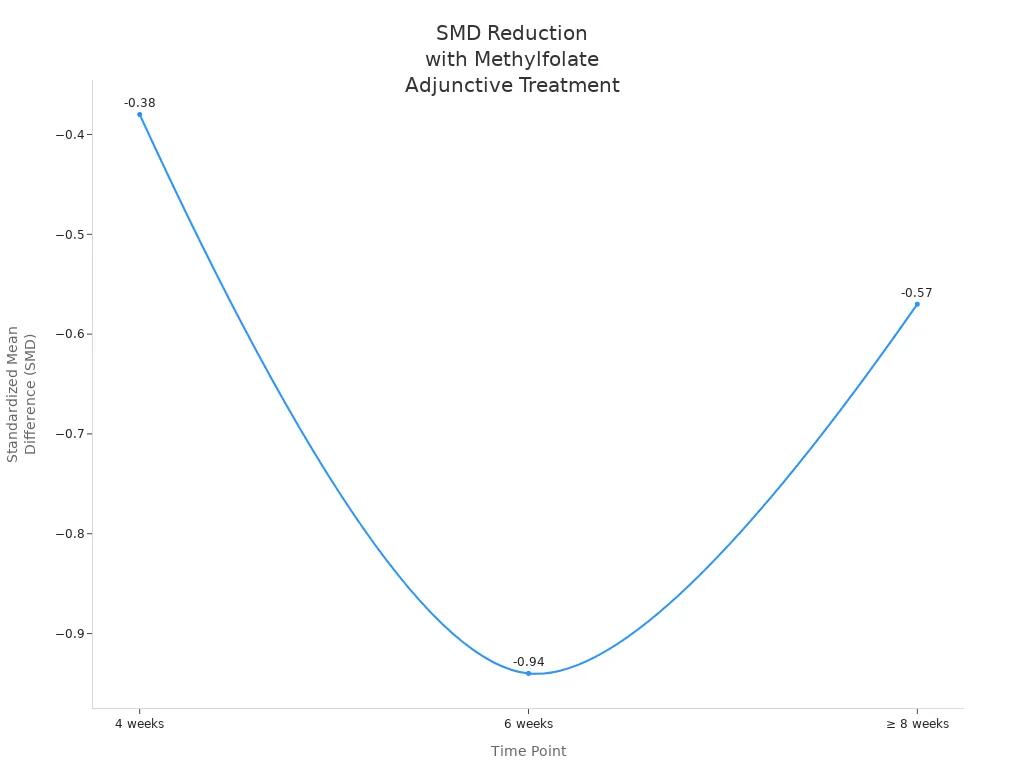
You may notice that the longer you use methylfolate, the more your depression symptoms can improve. This is great news if you have tried other options and want something that works.
Note: If you have the 677TT gene type or have not felt better with other treatments, methylfolate might give you the boost you need.
Treatment-Resistant Depression
Sometimes, depression does not get better with regular antidepressants. This is called treatment-resistant depression. If you feel stuck and nothing seems to help, you are not alone. Many people face this challenge.
Adding methylfolate to your routine can make a big difference. Studies show that people with treatment-resistant depression who use methylfolate as an add-on therapy see up to twice the improvement compared to those who use antidepressants alone. You might notice your mood lifting and your energy coming back.
Here’s a quick look at how methylfolate works in these tough cases:
- Patients with treatment-resistant depression often report better results when they add methylfolate to their treatment.
- The improvement in symptoms can be up to double compared to using antidepressants by themselves.
- People with certain genetic backgrounds, like the MTHFR mutation, may see even greater benefits.
Researchers tested different doses of methylfolate. In one trial, 7.5 mg/day did not show much change. But when they increased the dose to 15 mg/day, people saw much better results. Here’s a table that sums up the findings:
| Trial | Dosage | Outcome | Significance |
|---|---|---|---|
| First | 7.5 mg/day followed by 15 mg/day | No significant difference | N/A |
| Second | 15 mg/day | Significantly greater efficacy compared to placebo | Yes |
You might wonder if methylfolate works better alone or with other medicines. A large review looked at over 6,700 people with major depressive disorder. The results showed that using methylfolate with antidepressants improved the effectiveness of antidepressants. People were more likely to respond and feel better when they used both together.
| Evidence Type | Description |
|---|---|
| Study Design | Systematic Review and Meta-Analysis |
| Patient Population | 6,707 patients with major depressive disorder (MDD) |
| Findings | Adjunctive L-methylfolate improved antidepressant response compared to monotherapy |
| Effect Size | Relative risk: 1.25 (95% CI=1.08 to 1.46, p=0.004) for categorical response; Standardized mean difference: -0.38 (95% CI=-0.59 to -0.17, p=0.0003) for continuous measures |
| Conclusion | Modest efficacy of adjunctive L-methylfolate in enhancing antidepressant response in MDD patients |
If you have tried many treatments and still feel the signs of depression, methylfolate could be the missing piece. You do not have to give up hope. Many people find new relief when they add methylfolate to their plan.
Tip: If you notice the signs of depression are not going away, talk to your doctor about adding methylfolate. It could help you finally feel better.
Methylfolate Supplementation
Dosage and Safety
When you start methylfolate supplementation, knowing the right dose is important. Most people see the best results for depression and cognitive support at 15 mg per day, especially when used with antidepressants. Lower doses, like 7.5 mg, do not seem to help much. Some people use 5 mg per day to improve sleep, especially if they have MTHFR gene changes.
| Dosage (mg/day) | Effectiveness | Notes |
|---|---|---|
| 15 | Significant improvement in depression | Works well with SSRIs |
| 7.5 | No significant benefit | Lower dose not effective |
| 5 | Improved sleep quality | Good for sleep issues and MTHFR mutations |
You might wonder about side effects. Most people tolerate methylfolate supplementation well, but some notice mild problems. Here are the most common side effects:
- Sore muscles or aches
- Acne or rash
- Insomnia or irritability
- Nausea, headaches, or migraines
- Agitation or anxiety
- Gastrointestinal issues like nausea or bloating
If you feel any of these, talk to your doctor. Most side effects go away if you stop the supplement. Always start with the dose your healthcare provider recommends.
Tip: Keep track of how you feel after starting methylfolate supplementation. Your doctor may want to check your blood or ask about your mood and cognitive changes.
Who Should Consider It
You may benefit from methylfolate supplementation if you have trouble with mood, cognitive function, or if regular antidepressants do not work for you. Up to half of people with depression do not respond well to standard treatments. If you fall into this group, adding methylfolate supplements could help support mental clarity and improve your cognitive health.
People with MTHFR gene mutations often need methylfolate supplementation because their bodies cannot make enough active folate. Genetic testing can show if you have this mutation. Many people with depression, mood disorders, or even cardiovascular problems may benefit from this type of supplementation. Pregnant women and those with pregnancy complications may also need extra support.
You might be surprised to learn that many people with depression have MTHFR gene changes. In some studies, up to 76% of people with treatment-resistant depression had this mutation. Even if you do not know your genetic status, you can still talk to your doctor about methylfolate supplementation.
Note: Good nutrition and regular check-ins with your healthcare provider help you get the most from methylfolate supplementation. Your doctor may adjust your plan based on your symptoms, blood tests, and how you feel.
Methylfolate vs. Folic Acid
Effectiveness
You might wonder if methylfolate or folic acid works better for mental health. The answer depends on how your body uses these nutrients. Methylfolate is already in its active form, so your body can use it right away. Folic acid, on the other hand, needs to be changed by your body before it can help your brain.
- Methylfolate crosses the blood-brain barrier, but folic acid does not.
- Your brain needs methylfolate to make important chemicals like serotonin, dopamine, and norepinephrine. These help you feel happy and focused.
- Some people cannot turn folic acid into methylfolate because of their genes. If you have this problem, folic acid may not help your mood.
Doctors have found that methylfolate helps with depression, ADHD, and even bipolar disorder. Folic acid has not shown the same results in studies. In fact, small trials with folic acid did not help most people with depression, except for some women. Larger studies show that methylfolate works better, especially at a dose of 15 mg.
Tip: If you want the best results for your mood, methylfolate is usually the better choice.
Suitability
Not everyone’s body works the same way. Some people have a gene change called MTHFR. If you have this, your body cannot turn folic acid into the form your brain needs. This can lead to low folate levels, even if you take a lot of folic acid. You might also have more unmetabolized folic acid in your blood, which can cause problems for your immune system.
Here’s a quick look at the differences:
| Feature | Methylfolate | Folic Acid |
|---|---|---|
| Form | Active | Synthetic |
| Absorption | Direct | Needs conversion |
| Works for MTHFR? | Yes | No |
| Mental Health Support | Proven in studies | Limited evidence |
| Cost | Higher | Lower |
- Methylfolate is a good choice if you have trouble with mood, focus, or if regular treatments do not work.
- Folic acid is cheaper and found in many multivitamins, but it may not help everyone.
- Methylfolate is often not covered by insurance and can cost more.
Note: If you have questions about which supplement is right for you, talk to your doctor. They can help you decide based on your health and your genes.
L-methylfolate can boost your mood and help with depression, especially if standard treatments have not worked for you. Most people start with 15 mg daily and see benefits within weeks. You should always talk to your healthcare provider before trying methylfolate. Track your progress and watch for mild side effects. Here’s a quick look at safety:
| Treatment Type | Response Rate | Side Effects Comparison |
|---|---|---|
| l-Methylfolate (15 mg/day) + SSRI | 32% | Comparable to placebo |
| Placebo + SSRI | 15% | Comparable to l-Methylfolate |
Choosing methylfolate may be right for you if you want better mental health support. 😊
FAQ
Can you take L-methylfolate with other antidepressants?
Yes, you can. Many doctors recommend using L-methylfolate with antidepressants. This combo often helps you feel better faster. Always check with your doctor before you start.
How long does it take to notice results?
Most people see changes in mood or energy within two to four weeks. You might feel better sooner, but everyone is different. Keep track of your progress and share updates with your doctor.
Is L-methylfolate safe for daily use?
L-methylfolate is safe for most people. Side effects are usually mild and go away if you stop taking it. You should talk to your doctor before starting any new supplement.
Who should consider L-methylfolate?
You might benefit if you have depression, trouble with mood, or an MTHFR gene change. People who do not respond to regular treatments often see improvement with L-methylfolate.